Published in Market trends
When the home becomes the gallery: why art and design are reshaping Spain’s luxury property market
Art, interior design and collectible furniture are becoming key decision factors for luxury property buyers in Spain, as prime homes evolve into highly personal, gallery-like spaces.

- Blog
- Articles
- Market trends
- When the home becomes the gallery:...
For Spain’s luxury property market, design is no longer an afterthought. A decade ago, many buyers thought about interiors after the purchase had been agreed. Today, at the upper end of the market, design is increasingly part of the decision itself.
Location, light, views, privacy and architectural quality still define the foundations of a prime property. Without them, there is no serious value proposition. But once those essentials are in place, the question becomes more subtle: which home feels distinctive, coherent and capable of supporting a particular way of life?
That is where art and design are beginning to change the conversation.
In Spain’s most competitive prime markets, from Madrid and Barcelona to Mallorca, Ibiza, Marbella and the Costa Brava, buyers are looking for homes with a stronger sense of identity. They are not necessarily looking for something louder or more ostentatious. In many cases, the opposite is true. The preference is for spaces that feel edited, personal and culturally grounded, where the architecture, interiors, furniture and art work together rather than compete for attention.
This reflects a wider shift in luxury. The premium buyer increasingly takes excellent materials, technology and finishes for granted. What is harder to find is character: the right proportions, good natural light, ceiling height, silence, privacy, craftsmanship and a layout that feels intuitive. In this context, design is not simply about decoration. It helps a buyer understand the potential of a property and imagine how life might unfold there.
The idea of the home as a gallery does not mean turning a house into a museum. It is more nuanced than that. It means creating spaces that can hold art, furniture and daily life with equal confidence. For some buyers, this might mean walls with the right scale for large-format works, lighting that has been properly considered, controlled access, climate management and a natural flow through the home. For others, it is less about owning a major collection and more about living in a property that has been curated with intelligence.
This is especially relevant for international buyers, entrepreneurs and families with established patrimonies, many of whom have already had access to the best locations in the world. For them, a prime address is important, but it may not be enough on its own. What carries more weight is singularity: a home that could not easily be replicated elsewhere.
Madrid offers a clear example. In areas such as Salamanca, Chamberí, Jerónimos or El Viso, the appeal of a property often lies in the relationship between architecture and interior life. High ceilings, classical proportions, original details and generous rooms can provide the perfect backdrop for contemporary art and collectible furniture. The most successful homes are not those that erase the past, but those that allow it to converse with the present.
Barcelona has its own version of this. In Eixample, Turó Park, Pedralbes and parts of the old city, buyers are often drawn to properties with architectural depth and cultural context. A well-restored apartment with original features, contemporary interventions and carefully chosen pieces can feel far more compelling than a neutral luxury interior that could belong in any major city.
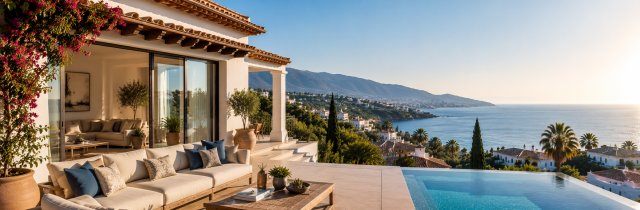
In the Balearics, Marbella and the Costa Brava, the gallery-home takes on a more Mediterranean character. Here, art and design are often connected to landscape, craft, materials and the rhythm of indoor-outdoor living. Stone, wood, ceramics, linen, sculptural furniture and local artwork can make a property feel rooted in its setting, rather than simply styled for sale.
Collectible design is also becoming part of the discussion. At the very top of the market, names such as Charlotte Perriand, Jean Royère or Diego Giacometti have helped move furniture from the language of decoration into the language of patrimony. A signed piece with provenance is not the same as a luxury sofa bought to fill a room. It can define the character of a space and, in some cases, hold value in its own right.
That distinction matters. Not every piece of designer furniture is an investment, just as not every artwork adds value to a home. Authorship, rarity, condition, provenance and documentation are essential. For property buyers, the more relevant point is often not whether the furniture or artwork is included in the sale, but whether the home has the scale, security, light and atmosphere to accommodate a serious collection.
For sellers, this creates an opportunity, but also a risk. A well-designed home can accelerate emotional decision-making because it reduces the distance between viewing a property and imagining a life inside it. It can make a home feel more complete, more memorable and less comparable. But over-styling can have the opposite effect. If the interior feels too personal, too trend-led or too disconnected from the architecture, it can narrow the pool of buyers.
The best luxury interiors tend to be confident rather than imposing. They suggest a way of living without closing down the buyer’s imagination. They give a home identity, but still leave room for the next owner to make it their own.
This is also becoming more relevant in new developments and turnkey homes. As buyers become more international, more mobile and more time-poor, many are looking for properties that are already resolved: architecture, interiors, lighting, furniture, landscaping and services considered as one complete experience. The attraction is not only convenience. It is certainty. A buyer can understand what they are purchasing, how it will function and how quickly they can start living there.
For developers, this means that design can no longer be treated as a final layer of marketing. It has to be part of the product from the beginning. Floor plans, ceiling heights, materials, light, storage, art walls, terraces and circulation all shape the way a home is perceived. In the prime segment, small details can have a disproportionate effect on value.
In Spain, where demand for high-quality homes remains strong and exceptional supply is limited, this search for individuality is likely to become more important. The most desirable homes will not simply be those with the highest specification, but those with the clearest sense of place and purpose.
The luxury home is becoming more curated, but not necessarily more theatrical. It is becoming more personal, but not necessarily more decorative. In the best cases, art and design do not sit on top of the property. They reveal what was already there.
In Spain’s prime market, singularity has become a form of scarcity. The homes that feel considered, personal and culturally grounded are often the ones that stay longest in the buyer’s mind.