Published in Market trends
Tagged with Buyer
Madrid’s luxury market in 2025: Holding its value, shaping investor confidence
Madrid’s prime property market in 2025 continues to hold its value, driven by strong demand, limited supply, and sustained investor confidence in the city’s most exclusive neighbourhoods.


- Blog
- Articles
- Market trends
- Madrid’s luxury market in 2025:...
Madrid’s prime residential market continues to show strength and composure.
While several European capitals are showing signs of slowdown, the Spanish capital continues to consolidate its position as one of Europe’s most resilient and attractive destinations for high-end investment.
According to Spain’s Instituto Nacional de Estadística (INE), housing prices in the region of Madrid rose by more than 13% year-on-year in the second quarter of 2025, outperforming the national average. Official data from the Comunidad de Madrid confirm that price stability and steady demand continue to define the market, particularly in established areas such as Salamanca, Chamberí, Justicia, Almagro, Retiro, and Jerónimos.
“Madrid has reached a new level of maturity,” says Paloma, CEO of Dils Lucas Fox. “We’re seeing sustained interest from both domestic and international clients who view the city as a long-term investment rather than a speculative market.''
A market defined by scarcity and stability
Most of the city’s prime housing stock consists of historic buildings, limited new development, and tightly controlled planning regulations. This combination keeps supply constrained and pricing firm.
Even as global markets adjust to higher interest rates and geopolitical uncertainty, Madrid’s upper segment continues to attract capital. The lack of available product, particularly in emblematic streets of Salamanca or the period buildings of Almagro, means competition for quality assets remains high.
For many investors, that scarcity is the key value driver. When assets are limited and held for the long term, volatility decreases, and the emphasis shifts from short-term appreciation to preservation of wealth.
Investment momentum
The fundamentals supporting Madrid’s position are clear. The Bank of Spain reports record levels of foreign investment in Spanish real estate through 2024, with Madrid accounting for more than half of total inflows. This momentum is underpinned by political stability, transparent regulation, and a fiscal environment that remains favourable to both private and institutional capital.
From an international perspective, Madrid offers relative value: prime properties here still trade below equivalent price levels in Paris, London, or Milan, yet the city delivers comparable lifestyle infrastructure, climate, and connectivity.
The character of prime
Each of Madrid’s top districts offers a distinct identity, but together they form a cohesive luxury core:
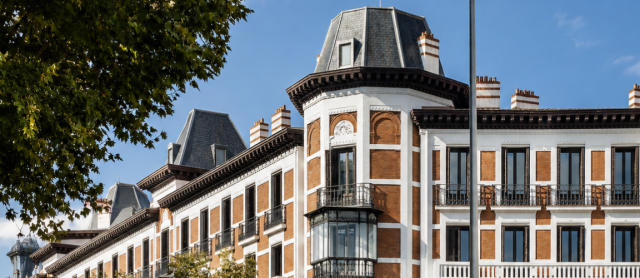
Salamanca and Jerónimos remain the benchmark for prestige, combining classical architecture and proximity to Retiro Park.
Chamberí and Almagro appeal to buyers seeking grand period residences with a quieter, more residential feel.
Justicia has evolved into a design-led enclave, blending heritage facades with contemporary interiors.
Retiro, anchored by its open green spaces, continues to perform strongly thanks to its limited turnover and enduring appeal.
These microlocations share the same fundamentals — heritage, accessibility, and constrained supply, the elements that define long-term value in Madrid.
Outlook: confidence, not Exuberance
Official data point to a market that is steady rather than speculative. Price growth is expected to moderate during 2025, but the fundamentals remain intact. Investors are approaching Madrid with a longer horizon, prioritising stability and capital preservation over short-term gains.
“Luxury real estate in Madrid has matured into a market defined by consistency,” Paloma adds. “It’s no longer about momentum, it’s about confidence. That’s why the best neighbourhoods are holding their value, and why Madrid continues to attract serious investors.”
For Dils Lucas Fox, that confidence is reflected in what the team sees daily on the ground: a prime market driven by real demand, finite supply, and lasting value.